How to review for the CET (college entrance test) as a busy SHS student: a study plan, free reviewers, flashcards, AI tools, and whether you need a review center.

Mariano Luiz King · PrepPH Founder
Published October 22, 2026

If you're in Grade 12 and taking more than one CET (college entrance test), the hard part isn't the topics. It's finding time. This post shows how I reviewed while juggling senior high, what worked, what wasted time, and which free tools I'd use today.
After reading this, you can build a simple CET review plan, pick free reviewers, and decide if you even need a review center.
I applied to several CETs while in senior high school. At the same time I had work immersion, regular exams, and a research paper due. Some weeks I had maybe an hour a day to review, and some weeks less.
This was before AI chat tools were common. If I didn't understand a problem, I had to search for it, ask a classmate, or just skip it.
What I used most was flashcards. Making them took a long time. But they worked, because they forced me to actually recall the answer instead of just rereading notes.
My batch didn't get a UPCAT. It wasn't held because of the pandemic. So I took what was available: the PLMAT, the DOST scholarship exam, the RTUCAT, the QCUCAT, the UCC admission test, and the SM Scholarship exam, plus a few others I've honestly forgotten.
It paid off. I passed the PLMAT and got into BS Computer Engineering at PLM (Pamantasan ng Lungsod ng Maynila):

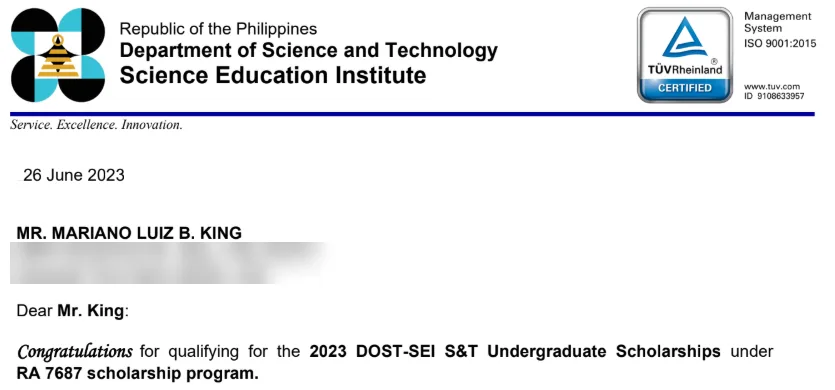
I also qualified for the 2023 DOST-SEI S&T Undergraduate Scholarship:
Every CET has a different mix. The UPCAT has Science, the ACET has General Information, and some have abstract reasoning. Don't review "everything." Review what's on your exams.
Start with the coverage posts:
Then list the topics they share. Math (algebra, word problems), English (grammar, vocabulary, reading comprehension), and logical reasoning show up on almost all of them. Those shared topics are where every hour pays off across exams.
Before you study anything, take one practice set under a timer. It will feel bad. That's the point.
You're looking for two things:
Write the score down. You'll compare against it later.
With school, immersion, and research, a 4-hour plan will fall apart by Wednesday. Plan for the bad weeks.
Here's a plan that fits a busy SHS schedule:
| Time | What to do |
|---|---|
| 20 to 30 min on weekdays | Flashcards or practice questions on your weakest subject |
| 10 min before sleep | Review only the cards you got wrong today |
| 1 to 2 hours on one weekend day | A timed practice set, then go through every mistake |
Short daily sessions beat one long cram on Sunday. You remember more when you review a little, often.
Rereading your notes feels productive. It mostly isn't. You recognize the words, so you think you know them.
Active recall means you try to answer from memory first, then check. Flashcards and practice questions do this automatically.
Example. Instead of rereading "the sum of interior angles of a polygon is (n − 2) × 180°," make a card:
Spaced repetition means you review a card right before you'd forget it. Cards you get right come back later. Cards you miss come back sooner.
On paper, I did a rough version of this with piles: "know it," "kinda," and "no idea." The "no idea" pile got reviewed daily. It works, but it's slow to manage by hand. Apps now do the scheduling for you.
Getting a question wrong only helps if you find out why. For each mistake, ask:
Back then, this step took me the longest because I had no one to ask. Today you can paste the question into an AI chat tool (an LLM, or large language model, like ChatGPT, Claude, or Gemini) and ask it to explain the answer step by step.
One warning: AI tools can be confidently wrong, especially on math. If the explanation doesn't match the answer key, trust the key and ask again, or check with a teacher.
| Tool | What it's good for | Downside |
|---|---|---|
| Paper flashcards | Cheap, no phone distractions, writing helps memory | Slow to make, hard to schedule reviews |
| Anki | Free (on desktop and Android), strong spaced repetition | Ugly at first, you make your own cards |
| Quizlet | Huge library of cards other students already made | Quality varies a lot, some features are paid |
| Gizmo | Turns your notes or PDFs into AI flashcards and quizzes | Free plan has limits, cards are only as good as your source |
| Khan Academy | Free lessons for math basics you forgot | Not built around Philippine CETs |
| prepPH | CET-style questions with explanations and spaced repetition built in | Free plan is 30 questions a day |
I compare these in more detail in Best Free CET Reviewer 2027.
I built prepPH because of the problem I had in SHS: making flashcards took longer than studying them. prepPH gives you ready-made questions per exam, like the UPCAT reviewer or the ACET reviewer, and schedules reviews with spaced repetition.
It's also made to work with AI. Each question has a copy button. It copies the subject, the question, and all the choices in a clean format, like this:
Subject: Mathematics

What is the sum of the interior angles of a hexagon?

A. 540°
B. 720°
C. 900°
D. 1080°
You paste that into ChatGPT, Claude, or Gemini and ask, "Explain this step by step" or "Give me 3 more questions like this." That's the thing I wished I had back then.
To be fair about the limits: the free plan gives 30 questions a day. Topic filters and weak-topic tracking are on the paid plan.
Not necessarily. A review center helps if:
You can skip it if you're disciplined enough to follow a plan, and you have free practice questions and a way to get explanations. Plenty of students pass CETs with free materials.
The middle ground: review on your own first. If after a few weeks you still can't get through math word problems, pay for help on that one subject instead of a full program.
I didn't go to a review center, so I can't compare one first-hand. When past takers talk about it online, they tend to split two ways. Some say the fixed schedule and mock exams kept them from procrastinating. Others say they passed with free reviewers and practice tests, and that the money was better spent elsewhere. Both groups agree on one thing: the review center doesn't study for you.
I made too many cards before studying any. I spent whole weekends writing cards. I should have made fewer and started reviewing sooner.
Two more mistakes I'd watch out for:
I'd start with one timed test, focus on the overlapping topics, and let an app handle the spaced repetition. I'd still use flashcards, because they work. I'd just stop making them all by hand.
There's no fixed number. If you study 30 minutes a day, starting 2 to 3 months before your first exam gives you enough time to cover shared topics and do several timed tests.
Many students do. Free tools give you practice questions and spaced repetition. What matters more is reviewing consistently and learning from mistakes. No reviewer, free or paid, can guarantee you'll pass.
Math and English show up on almost every CET. Check each exam's coverage, then start with the subject you scored lowest on in your first practice test.
Yes, as a tutor. Use it to explain answers and make similar practice questions. Double-check math answers, since AI tools can make mistakes.
Want to start now? Try the free CET reviewers and mock exam questions.