What spaced repetition is, what the research actually says about it, and how the SM-2 formula schedules your flashcards, with a worked example.

Mariano Luiz King
Published November 6, 2026 · Updated November 9, 2026
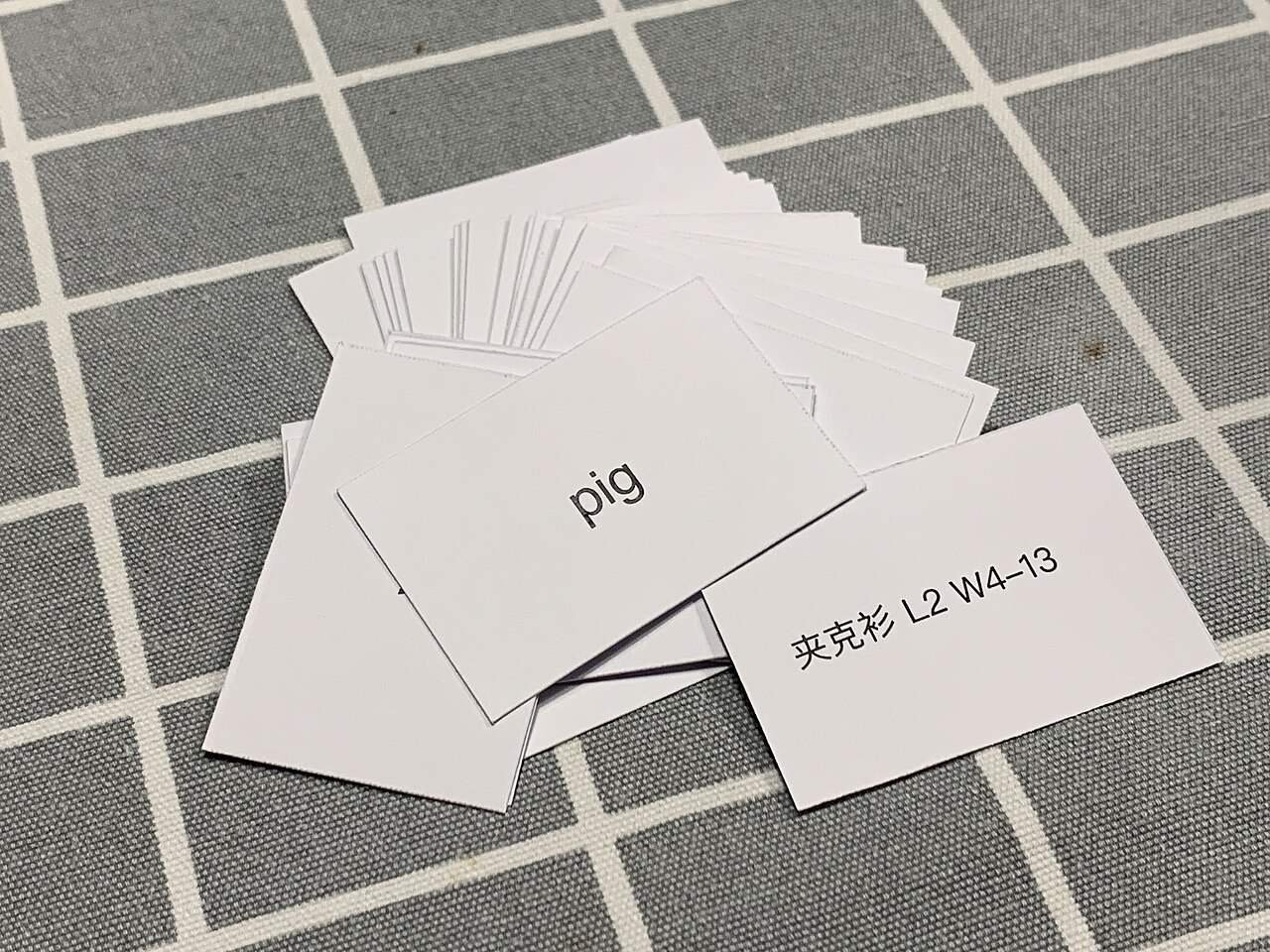
Spaced repetition means reviewing something right before you'd forget it, then waiting longer each time you get it right. Combine it with testing yourself (instead of rereading) and you remember more with the same study time. This post explains what the research actually found, how the SM-2 formula behind many flashcard apps decides when you see a card, and how to use it for an entrance or board exam.
After reading this, you can explain why spaced flashcards beat rereading, and set up a review routine that uses both ideas.
In senior high school, I reviewed for my college entrance tests with paper flashcards. Making them took whole weekends, but they worked, because they forced me to recall each answer instead of rereading my notes.
To keep this honest, I'm citing the studies directly instead of the usual "studies show." I read the abstract of each paper below on PubMed, plus SuperMemo's own description of SM-2, the scheduling formula behind many flashcard apps. Where the research has limits, I'll say so.
People mix these up, so let's separate them:
Spaced repetition apps combine both. They quiz you, and they schedule the quizzes with growing gaps.
In 2006, Roediger and Karpicke had students study prose passages. Some reread them. Others took recall tests on them without feedback. Then everyone took a final test after 5 minutes, 2 days, or 1 week.
The result is a little surprising:
That last point explains why rereading is so popular. It feels like it's working. Your notes look familiar, so you think you know them. But familiar isn't the same as recallable.
Cepeda and colleagues (2006) ran a meta-analysis, which means they combined the results of many earlier studies. They pulled together 839 measurements from 317 experiments in 184 articles about spacing.
Their main finding: the best gap between study sessions depends on how long you need to remember. The longer the time until your test, the longer the ideal gap.
Here's what that means for you. If your exam is next week, short gaps (a day or two) make sense. If it's months away, your reviews should spread out to weeks.
Dunlosky and colleagues (2013) reviewed 10 common study techniques. They rated each one by how well its benefits held up across ages, abilities, subjects, and kinds of tests.
| Rating | Techniques |
|---|---|
| High utility | Practice testing, distributed (spaced) practice |
| Moderate utility | Elaborative interrogation (asking "why?"), self-explanation, interleaved practice (mixing topics) |
| Low utility | Summarization, highlighting, the keyword mnemonic, imagery for text, rereading |
The authors say highlighting and rereading don't consistently boost performance, and suggest practice testing instead of rereading. The two high-utility methods are exactly what spaced flashcards combine.
One honest limit: "low utility" doesn't mean useless. Rereading still helps you understand a topic the first time. It's just a weak way to keep it.
SM-2 is a scheduling formula Piotr Wozniak created for the SuperMemo program in 1987. Many flashcard apps use it or a variation of it. Anki used SM-2 for years and now also offers a newer scheduler called FSRS.
SM-2 tracks three numbers per card:
The rules:
Ease never goes below 1.3. Wozniak added that floor because cards with lower ease came back "annoyingly often" and usually just needed rewriting.
I built prepPH, a review app for Philippine exams, so take this as one example, not the only way. It uses SM-2 with two changes I can point to in its code: the second interval is 3 days instead of 6, and a multiple choice answer is scored as either fully right or fully wrong. A right answer adds 0.1 to the card's ease. A wrong answer takes away 0.2.
Here's one card, answered correctly every time:
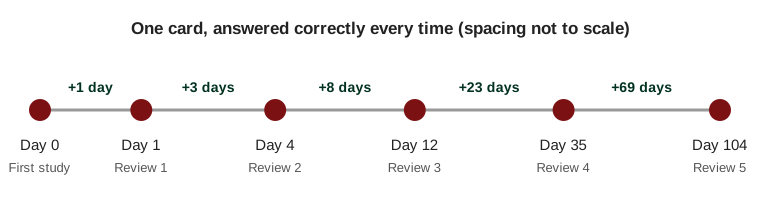
| Review | Ease after | Gap until next review | Day |
|---|---|---|---|
| First study | 2.6 | 1 day | 0 |
| Review 1 | 2.7 | 3 days | 1 |
| Review 2 | 2.8 | 3 × 2.8 = 8 days | 4 |
| Review 3 | 2.9 | 8 × 2.9 = 23 days | 12 |
| Review 4 | 3.0 | 23 × 3.0 = 69 days | 35 |
Five correct reviews carry the card past three months. Now say you get it wrong at review 3. The gap resets to 1 day, the streak starts over, and the ease drops to 2.6. The card comes back often until you know it again.
That's the whole trick. Cards you know fade into the background. Cards you don't know keep showing up.
If you make your own cards, Anki is free and very good at this. I built prepPH, so I'm biased, but it does the scheduling for you on exam-style multiple choice questions, so you skip making the cards. Both use the same basic idea.
Rereading feels productive because it makes notes look familiar. Testing yourself feels harder because you find out what you don't know. The research says to pick the harder one, and to spread it out. Spaced flashcards are the easiest way I know to do both without planning a schedule yourself.
For the full study plan, see how to review for the CET or how to review for the PRC board exam.
A study method where you review material at growing intervals, timed to come right before you'd forget it. Apps usually combine it with active recall, like flashcards.
According to the research reviewed here, yes, for long-term memory. Dunlosky and colleagues rated distributed practice and practice testing as high utility, and rereading as low utility.
A scheduling formula from SuperMemo (1987). After two short reviews, each new interval is the old interval times an "ease" number that grows when you answer correctly and drops when you miss.
It depends on when your test is. Cepeda and colleagues found the best gap gets longer as the time until the test gets longer.
Anki was based on SM-2 and still offers it, but it now also has a newer scheduler called FSRS.
To try spaced repetition on exam-style questions, start from the free reviewer pages.