How abstract reasoning works in Philippine college entrance exams like the PLMAT and PUPCET: 6 patterns, worked examples, and a fast way to solve them.

Mariano Luiz King
Published November 6, 2026 · Updated November 9, 2026
Abstract reasoning questions show you a series of shapes and ask what comes next, or which one doesn't belong. In the Philippines, they're part of several college entrance exams, like the PLMAT and PUPCET. They look random at first, but most of them use the same few rules: things rotate, move, add up, alternate, or get mirrored. This post shows those patterns with original examples, and a checklist for spotting them fast.
After reading this, you can solve a basic abstract reasoning question by checking the patterns in a fixed order instead of staring at it.
Each of these is one university's own admission test:
| Exam | Where it shows up |
|---|---|
| PLMAT (Pamantasan ng Lungsod ng Maynila Admission Test) | Its own section, 30 items in 10 minutes |
| PUPCET (Polytechnic University of the Philippines College Entrance Test) | Its own section |
| USTET (University of Santo Tomas Entrance Test) | Inside the 80-item Mental Ability subtest |
| ACET (Ateneo College Entrance Test) | Inside Mental Ability and Reasoning, as "shapes and patterns" |
The schools don't publish detailed exam content. So the item counts, time limits, and question types here come from people who've taken these tests.
I took the PLMAT myself, a few cycles ago, but I don't remember its specific questions. And I wouldn't share them if I did. Every example below is one I made for this post. None are copied from a real exam.
On the PLMAT, 30 items in 10 minutes gives you 20 seconds per question. Most abstract reasoning questions aren't hard once you see the rule. The problem is finding the rule fast.
That's why a fixed checklist helps. Instead of looking at everything at once, you check one thing at a time and stop when you find it.
Something turns by the same amount each step.
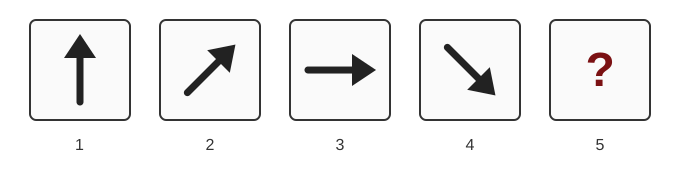
What's in box 5? The arrow turns 45° clockwise each step: up, up-right, right, down-right. So box 5 is an arrow pointing straight down.
How to check: pick one end of the shape (the arrowhead here) and follow it box to box. If it moves the same amount each time, it's rotation. Watch the direction. A common trap is an answer choice that turned the right amount but the wrong way.
Something increases or decreases by a fixed number. It can be sides, dots, lines, or shaded parts.
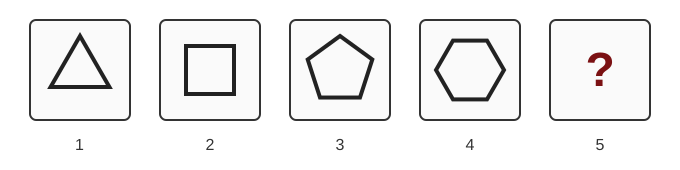
What's in box 5? Count the sides: 3, 4, 5, 6. Each step adds one side, so box 5 is a shape with 7 sides (a heptagon).
How to check: count everything countable. Sides, corners, dots, lines, and enclosed spaces. Write the numbers down if you need to. If they go up or down by the same step, you've found it.
Something slides to a new position each step, often around the corners or edges of the box. It can also move one square at a time across a grid.
You'll see movement in the next example, combined with another rule.
Two things take turns: circle, square, circle, square. Or shaded, unshaded, shaded.
Harder questions combine two simple rules. Most people get stuck because they find one rule and pick an answer that only fits that one.
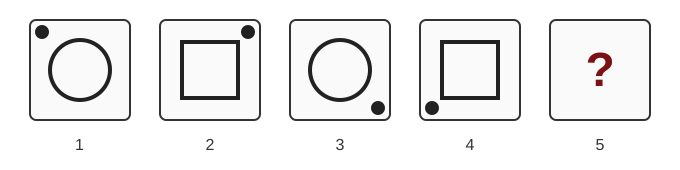
What's in box 5? There are two rules here:
The answer is a circle with the dot at the top-left. It looks the same as box 1, which is a nice check. Patterns that loop often come back to the start.
In a real exam, the wrong choices would include a square with a top-left dot, and a circle with the dot somewhere else. Each of those fits one rule but not both.
Two other question types show up in reviewers and practice sets:
When you see a series, check in this order and stop as soon as something fits:
Then eliminate answer choices instead of drawing the answer yourself. If the rule says the dot must be top-left, cross out every choice where it isn't. That's usually faster than imagining the full figure.
If you can't find a rule in about 20 seconds, guess, mark it, and move on. Spending a minute on one item can cost you three easier ones.
I built prepPH, so I'm biased, but this is why it has an Abstract Reasoning deck with image questions: figure sequences, odd one out, mirror images, and domino patterns. It's included in the practice for the ACET, DCAT (De La Salle College Admission Test), USTET, PLMAT, and PUPCET.
Abstract reasoning is the most learnable section on most entrance tests. There's no content to memorize, just a short list of rules. Learn the checklist, practice with a timer, and the 20 seconds per item stops feeling impossible.
It's a set of questions using shapes instead of words or numbers. You find the rule behind a series of figures and pick what comes next, or which figure doesn't belong.
No. The UPCAT's four subtests are Language Proficiency, Reading Comprehension, Science, and Math.
About 30 items in 10 minutes. PLM doesn't publish official item counts.
Check one rule at a time: count, rotate, move, alternate, then look for a second rule. Eliminate answer choices instead of drawing the answer yourself.
Yes. The question types repeat, so timed practice on many different items helps you spot the rules faster.
Practice figure questions on the free abstract reasoning reviewer, or take full mock questions with the PLMAT reviewer or PUPCET reviewer.